Today I went to the book sale and bought William A. Haviland's "Cultural Anthropology" and guess what I found on the first page??? An explanation for anthropology:
"[... ]Anthropology, the study of humankind, seeks to produce useful generalizations about people and their behavior and to arrive at the fullest possible understanding of human diversity. [...] Physical anthropologists study humans as biological organisms, tracing the evolutionary development of the human animal and looking at the biological variations within this species. Cultural anthropologists are concerned with human cultures, or the ways of life in societies. Within the field of cultural anthropologists are archeologists, who seek to explain human behavior by studying matererial objects, usually from past cultures; linguists, who study languages, by which cultures are maintained and passed on to succeeding generations; and ethnologists, who study cultures as they can be experienced and discussed with persons whose culture is to be understood."
Thursday, November 02, 2006

Wednesday, November 01, 2006
UN
I was curious and had to find out the requirements myself (Sorry, Julie and ES!!!)
"Membership in the United Nations is open to all peace-loving states which accept the obligations of the Charter and, in the judgement of the Organization, are willing and able to carry out these obligations.
The admission of any such State to membership in the United Nations will be effected by a decision of the General Assembly upon the recommendation of the Security Council."
How does a new State or Government obtain recognition by the United Nations?
How does a country join the UN as a Member State?
"Membership in the United Nations is open to all peace-loving states which accept the obligations of the Charter and, in the judgement of the Organization, are willing and able to carry out these obligations.
The admission of any such State to membership in the United Nations will be effected by a decision of the General Assembly upon the recommendation of the Security Council."
Article 4, Chapter 2, United Nations Charter
How does a new State or Government obtain recognition by the United Nations?
How does a country join the UN as a Member State?
The recognition of a new State or Government is an act that only States and Governments may grant or withhold. It generally implies readiness to assume diplomatic relations. The United Nations is neither a State nor a Government, and therefore does not posses any authority to recognize either a State or a Government. As an organization of independent States, it may admit a new State to its membership or accept the credentials of the representatives of a new Government.
Membership in the Organization, in accordance with Paragraph I of Article 4 of the Charter of the United Nations, "is open to all peace-loving States which accept the obligations contained in the United Nations Charter and, in the judgment of the Organization, are able to carry out these obligations." States are admitted to membership in the United Nations by decision of the General Assembly upon the recommendation of the Security Council. The procedure is briefly as follows:
1. The State submits an application to the Secretary-General and a formal declaration stating that it accepts the obligations under the Charter.
2. The application is considered first by the Security Council. Any recommendation for admission must receive the affirmative votes of nine of the 15 members of the Council, provided that none of its five permanent members - China, France, the Russian Federation, the United Kingdom of Great Britain and Northern Ireland and the United States of America - have voted against the application.
3. If the Council recommends admission, the recommendation is presented to the General Assembly for consideration. A two-thirds majority vote is necessary in the Assembly for admission of a new State, and membership becomes effective the date the resolution for admission is adopted.
At each session, the General Assembly considers the credentials of all representatives of Member States participating in that session. During such consideration, which routinely takes place first in the 9-member Credentials Committee but can also arise at other times, the issue can be raised whether a particular representative has been accredited by the Government actually in power. If controverted, this issue is ultimately decided by a majority vote in the Assembly. It should be noted that the normal change of Governments, as through a democratic election, does not raise any issues concerning the credentials of the representative of the State concerned.Tuesday, October 31, 2006
"Cowboy Nation"

Robert Kagan’s provocative piece “Cowboy Nation” details what he sees as the desire for empire as war being part of our American blood. He wrote, “The early United States was an expansionist power from the moment the first pilgrim set foot on the continent; and it did not stop expanding—territorially, commercially, culturally, and geopolitically—over the next four centuries. The United States has never been a status quo power; it has always been a revolutionary one, consistently expanding its participation and influence in the world in ever-widening arcs. The impulse to involve us in the affairs of others is neither a modern phenomenon nor a deviation from the American spirit. It is embedded in the American DNA”.
What is interesting about this argument is Kagan emphasis that our liberal (not current political nor IR term, but idea of the individual) tradition leads us to see ourselves as able to spread liberty. Furthermore we as a nation see it or our destiny as listed in the Declaration (Kagan sees it as the defining document of the American mantra) to spread our empire.
I think Kagan needs to emphasize that despite our goals toward liberty, we still act in accordance to what serves us. Currently actions in Africa or other parts of the world could be seen as spreading liberty, but they do little to serve our national interest.
This article is important to our study because it reminds us to examine ourselves without forgetting that our past is not ideal. Furthermore the idea makes both sides examine their roots. The question of doing good is troublesome for us because it can embroil us in conflicts that neither suit us or that we cannot solve. Perhaps the lyrics of a Rolling Stones song have applicability here. Instead of fighting our past, we should have some “sympathy for the devil”.
"Please allow me to introduce myself
Im a man of wealth and taste
Ive been around for a long, long year
Stole many a mans soul and faith
And I was round when jesus christ
Had his moment of doubt and pain
Made damn sure that pilate
Washed his hands and sealed his fate
Pleased to meet you
Hope you guess my name
But whats puzzling you
Is the nature of my game
I stuck around st. petersburg
When I saw it was a time for a change
Killed the czar and his ministers
Anastasia screamed in vain
I rode a tank
Held a generals rank
When the blitzkrieg raged
And the bodies stank
Pleased to meet you
Hope you guess my name, oh yeah
Ah, whats puzzling you
Is the nature of my game, oh yeah
I watched with glee
While your kings and queens
Fought for ten decades
For the gods they made
I shouted out,
Who killed the kennedys?
When after all
It was you and me
Let me please introduce myself
Im a man of wealth and taste
And I laid traps for troubadours
Who get killed before they reached bombay
Pleased to meet you
Hope you guessed my name, oh yeah
But whats puzzling you
Is the nature of my game, oh yeah, get down, baby
Pleased to meet you
Hope you guessed my name, oh yeah
But whats confusing you
Is just the nature of my game
Just as every cop is a criminal
And all the sinners saints
As heads is tails
Just call me lucifer
cause Im in need of some restraint
So if you meet me
Have some courtesy
Have some sympathy, and some taste
Use all your well-learned politesse
Or Ill lay your soul to waste, um yeah
Pleased to meet you
Hope you guessed my name, um yeah
But whats puzzling you
Is the nature of my game, um mean it, get down
Woo, who
Oh yeah, get on down
Oh yeah
Oh yeah!
Tell me baby, whats my name
Tell me honey, can ya guess my name
Tell me baby, whats my name
I tell you one time, youre to blame
Ooo, who
Ooo, who
Ooo, who
Ooo, who, who
Ooo, who, who
Ooo, who, who
Ooo, who, who
Oh, yeah
Whats me name
Tell me, baby, whats my name
Tell me, sweetie, whats my name
Ooo, who, who
Ooo, who, who
Ooo, who, who
Ooo, who, who
Ooo, who, who
Ooo, who, who
Ooo, who, who
Oh, yeah"
Monday, October 30, 2006
Some words of hope
"A little patience, and we shall see the reign of witches pass over, their spells dissolve, and the people, recovering their true sight, restore their government to its true principles. It is true that in the meantime we are suffering deeply in spirit, and incurring the horrors of a war and long oppressions of enormous public debt. If the game runs sometimes against us at home we must have patience till luck turns, and then we shall have an opportunity of winning back the principles we have lost, for this is a game where principles are at stake."
Thomas Jefferson
Thomas Jefferson
Mark Moberg - Responsible Men and Sharp Yankees
Essence of the essay:
Moberg discusses the strategies employed by United Fruit to monopolize the banana export industry in British Honduras (known today as Belize) and how these strategies affect the relationship between "the colonial state, traditional elites, and the United Fruit Company. In the essay he traces the history of United Fruit in British Honduras from the time the company was invited to operate early in the 20th century until the time the company abandoned their contract in 1920.
Short summary:
The intentions of United Fruit are made clear in the essay; the company moves in, develops a monopoly, and exploits the land of British Honduras. A contract between United Fruit Company and British Honduras was formed. United Fruit was to produce and export agriculture for 25 years and in return the government would provide the company cheap land and a new railway system for transportation of goods. The company was able to buy land for $1 per acre, whereas private farmers had to pay nearly $8 per acre.
The land was infected with Panama Disease circa 1914 and the disease slowly spread causing most of the land owned by United Fruit to be unsuitable for the growth of banana plants. Shortly after this disaster struck the company pulled out of British Honduras and offered to sell the land back for twice the price at which it was purchased. In the conclusion, Moberg mentions the present situation with the banana export industry in Belize.
One idea that I may look into for a future blog is the outcome of the suit that was initiated by Chiquita (the successor of United Fruit) through WTO. The suit was meant to end the tariff quota system that allowed ACP fruit to export a certain amount of fruit with reduced taxation. If the ruling passes, "United Fruit will have dismantled a banana industry that played a major role in the company's own growth".
Moberg discusses the strategies employed by United Fruit to monopolize the banana export industry in British Honduras (known today as Belize) and how these strategies affect the relationship between "the colonial state, traditional elites, and the United Fruit Company. In the essay he traces the history of United Fruit in British Honduras from the time the company was invited to operate early in the 20th century until the time the company abandoned their contract in 1920.
Short summary:
The intentions of United Fruit are made clear in the essay; the company moves in, develops a monopoly, and exploits the land of British Honduras. A contract between United Fruit Company and British Honduras was formed. United Fruit was to produce and export agriculture for 25 years and in return the government would provide the company cheap land and a new railway system for transportation of goods. The company was able to buy land for $1 per acre, whereas private farmers had to pay nearly $8 per acre.
The land was infected with Panama Disease circa 1914 and the disease slowly spread causing most of the land owned by United Fruit to be unsuitable for the growth of banana plants. Shortly after this disaster struck the company pulled out of British Honduras and offered to sell the land back for twice the price at which it was purchased. In the conclusion, Moberg mentions the present situation with the banana export industry in Belize.
One idea that I may look into for a future blog is the outcome of the suit that was initiated by Chiquita (the successor of United Fruit) through WTO. The suit was meant to end the tariff quota system that allowed ACP fruit to export a certain amount of fruit with reduced taxation. If the ruling passes, "United Fruit will have dismantled a banana industry that played a major role in the company's own growth".
Sunday, October 29, 2006
North vs South

Haha... Probably you all need to play some North vs South. Even as a European, I remember playing this action game on the NES ( That was the Nintendo Entertainment System from the late 80s, early 90s). So much fun...
Striffler, "The Logic of the Enclave: United Fruit, Popular Struggle, and Capatalist Transformation in Ecuador"
Striffler’s chapter focused on the presence and eventual departure of the United Fruit Company from Ecuador during the years 1930’s to 1962. He traced the evolution of the company from having widespread power to that of readjusting due to dissent from local peasants and workers.
From the initial presence of the company, local peasants constantly threatened its property rights. The government was not a reliable source of power for either side. Both were armed and enforced their own rules. Interestingly, the UFC treated its workers relatively well, which virtually eliminated their dissent. The spread of Panama disease required UFC to spread, which was the harbinger of the company having to leave. When it sought new land peasants fought it at every turn making the company acquiesce and grant them tenant rights. Finally in 1962 the company completed its switch to contracts to gain the commodity of bananas, which it so dearly desired.
The interesting point is that while the peasants gained property rights, they did so only to fall under a new institution of native capitalists who were less fair then the UFC. The UFC and others still remained able to gain their products.
I think this is an unfortunate occurrence when people gain rights only to be re-subjected to another, crueler rule. It seems as if the North will leave when it realizes what it can do to maintain its own needs. Furthermore it illustrates that the capitalist world system will find a way to survive no matter who is in charge, which highlights the decline of state/individual sovereignty. Good Night.
From the initial presence of the company, local peasants constantly threatened its property rights. The government was not a reliable source of power for either side. Both were armed and enforced their own rules. Interestingly, the UFC treated its workers relatively well, which virtually eliminated their dissent. The spread of Panama disease required UFC to spread, which was the harbinger of the company having to leave. When it sought new land peasants fought it at every turn making the company acquiesce and grant them tenant rights. Finally in 1962 the company completed its switch to contracts to gain the commodity of bananas, which it so dearly desired.
The interesting point is that while the peasants gained property rights, they did so only to fall under a new institution of native capitalists who were less fair then the UFC. The UFC and others still remained able to gain their products.
I think this is an unfortunate occurrence when people gain rights only to be re-subjected to another, crueler rule. It seems as if the North will leave when it realizes what it can do to maintain its own needs. Furthermore it illustrates that the capitalist world system will find a way to survive no matter who is in charge, which highlights the decline of state/individual sovereignty. Good Night.
One Hundred Years of United Fruit Company Letters
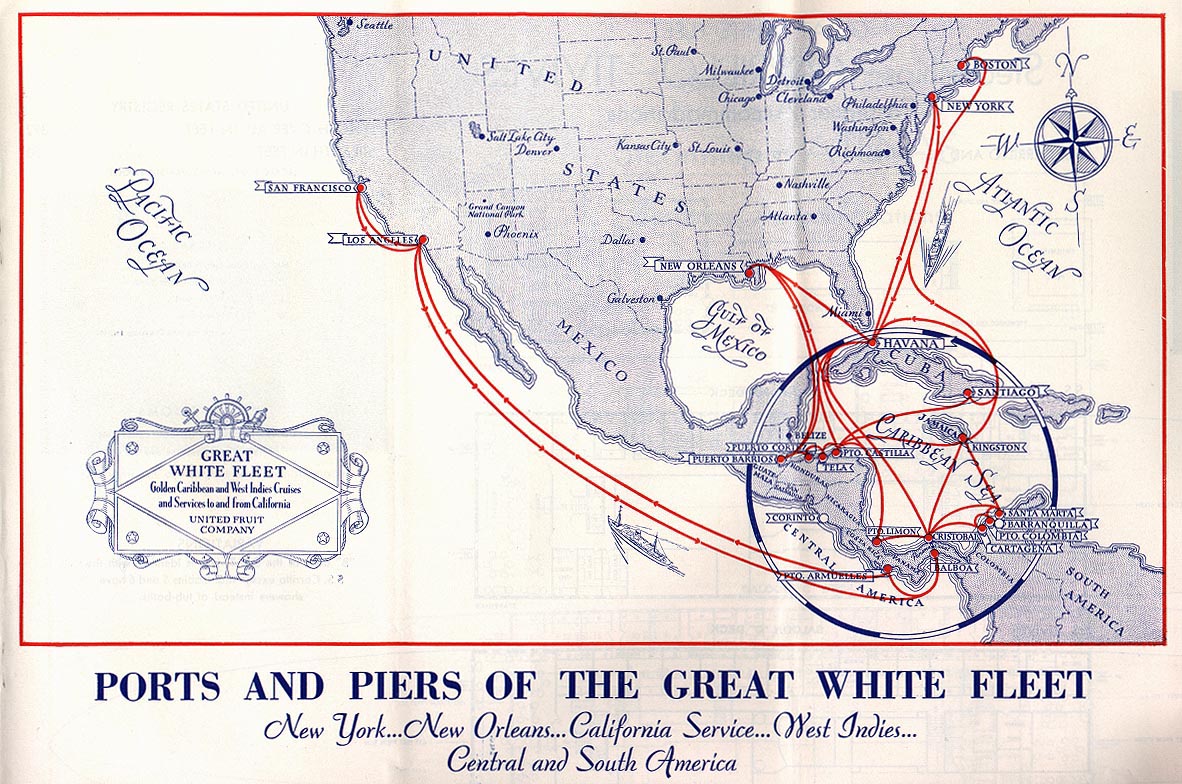
Phillippe Bourgeois, Professor and Chair of the Department of Anthropology, History and Social Medicine at the University of California, examines the role of the United Fruit Company in his essay "One Hundred Years of United Fruit Company Letters."
Bourgeois defines the United Fruit Company as "a quintessential model for the institutional form of the multinational corporation that has changed the face of the world during the 20th century." By looking at the "discussions, reports, and directives by managers, lawyers, accountants, undercover informants, and lobbyists [...]" from archival documents (1914-1970) , he examines the company's policy towards the banana plantations on the boarder of Costa Rica and Panama.
To achieve his initial idea, he splits his essay in three parts: In the first part, he concentrates on the relationship between the "host-countries" (Costa Rica and Panama) and the United Fruit Company and how the United Fruit Company managed to influence the host-countries' governments. In the second and in the third part, Bourgeois comes up with examples of how the company tried to keep their workers under control and how the company reacted towards possible unionism and occasional uproar.
But all parts do ultimately contribute to Bourgeois' s central topic, this is to say how the multinational corporation (in this case, the United Fruit Company) "has replaced the international corporate form, which had dominated the colonial era through governmental sponsored international trade monopolies."
Subscribe to:
Comments (Atom)